
Offshoring and AI are being cut into HR quietly. Here is what I'm seeing, and where I think it ends.
Everyone assumed AI would end offshoring. Why pay a team in Manila when software can do the work? That is not what is happening. The two are arriving together, and HR is one of the functions in the middle of it.
1. The cuts don't look like cuts
I haven't seen many HR redundancies. What I have seen is HR operations teams getting smaller. Lower-level roles aren't being replaced when someone leaves, and some generalists are being redeployed into specialist HR teams. Nothing in that makes a headline. Nobody announces "we're making HR smaller". It's called simplification.
2. HR is named, but nobody says how many
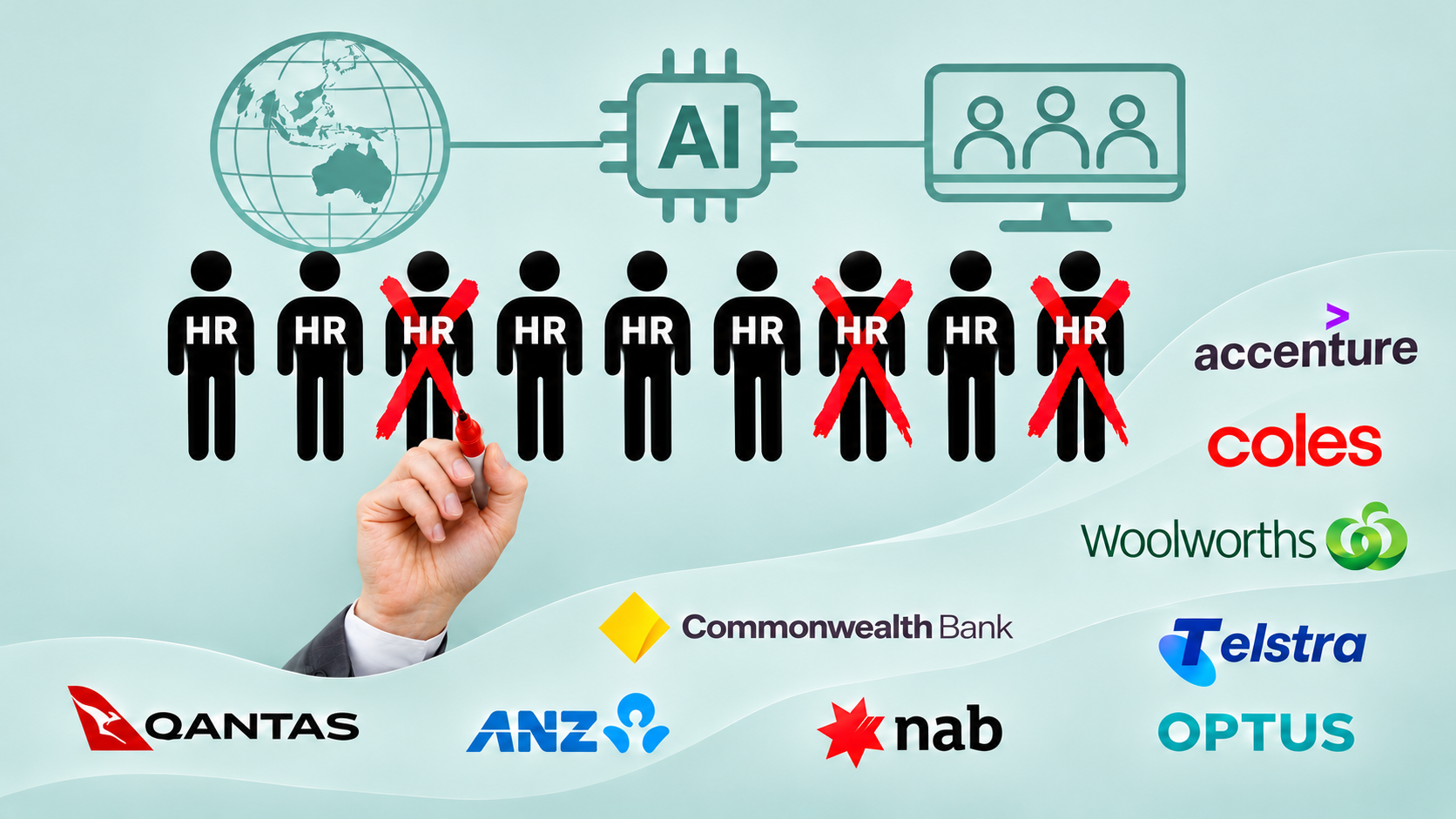
Qantas has put its people function in the first phase of roles moving to Accenture, with the work delivered mostly from India. Coles has named HR among the functions moving to Accenture, and Woolworths has been reported to be offshoring HR alongside finance and IT. The Finance Sector Union has reported HR roles among cuts at CBA and ANZ. Not one of these comes with an HR number. HR is being counted inside "corporate services", which is why the profession can't see its own shrinkage.
3. The bottom rung goes first
My prediction: the entry-level HR role (coordinator, administrator, junior generalist) shrinks fastest. Moving generalists up into specialist teams is sensible today, but it uses up the pipeline. Where do the senior HR leaders of the future learn the work?
4. AI was supposed to replace offshoring. It's recruiting it
This is my reading, not a reported fact. The hubs in India and the Philippines have become very good at running AI, and companies want that capability. Qantas has framed its Accenture deal partly around skills it can't easily hire onshore. Telstra's AI joint venture with Accenture works through an India hub. In one survey of Australian employers, most said their offshore teams were adopting AI as fast as, or faster than, their onshore ones. The more AI there is, the more the work follows whoever operates it best.
5. The case against, fairly
Plenty of people will disagree. Some argue the Qantas story is simple offshoring, with AI as a convenient headline. Gartner's modelling attributes very little of today's job loss to AI productivity. Optus is reportedly bringing some work back from India. CBA reversed AI-driven redundancies in 2025 after getting the assessment wrong. All of that is true. None of it changes where the transactional HR work is heading.
6. The knowledge gap is an HR problem first
HR operations is where the function learns how the machine really works: how payroll breaks, how awards are applied, how a messy case unfolds. If that work, and the AI tooling that goes with it, moves offshore, Australia's keeps the decisions and loses the understanding. UTS and Sydney Uni researchers have called this Australia's "corporate brain" problem. In HR, it will show up the first time an onshore leader has to judge whether a system got something wrong and nobody nearby has ever done it by hand.
7. I think this is the first wave, not the last
The public numbers point one way. The Finance Sector Union estimates more than 10,000 banking roles have gone in two years, and NAB's cuts run to mid-2027. I'm also hearing that more large-scale redundancies are coming next year. HR will be part of that.
That matters for HR because of where I think the structure ends up. When I mapped a future HR function, I said it would be leaner but with more interesting specialist roles: AI trainers, workforce analysts, human-AI specialists. I didn't ask where those roles would sit. My prediction: a thin onshore layer of advisers, employee relations and leadership, and a delivery layer, along with the new AI roles, wherever the capability already is. If I'm right, the quiet attrition in HR operations I'm seeing now is the early part of a longer shift.
So here is the question I'd leave you with: in 5 years, who in an Australian HR team will know how the work actually gets done?
References
Qantas CEO staff announcement and HCA coverage (10 Nov 2026), Accenture agreement covering finance, procurement, people and marketing roles.
Coles Group, expanded Accenture agreement (Aug 2026).
Woolworths Group, offshoring consultation (June 2026), reported by ABC and AFR.
Finance Sector Union, CBA job cuts (Feb 2026) and ANZ restructure notices (early 2026); FSU estimate of more than 10,000 banking roles lost over two years.
HCA (Oct 2026), NAB to cut up to 2,500 roles by mid-2027.
UTS and Sydney Uni, "Australia risks losing its corporate brain" (June 2026).
John Quiggin, The Guardian, on Qantas and offshoring (Nov 2026).
Gartner, AI and job loss forecasts; CFOtech Australia, survey of Australian employers on offshore AI adoption.
Capability HR, "REVEALED – The Future HR Structure!" (13 Nov).